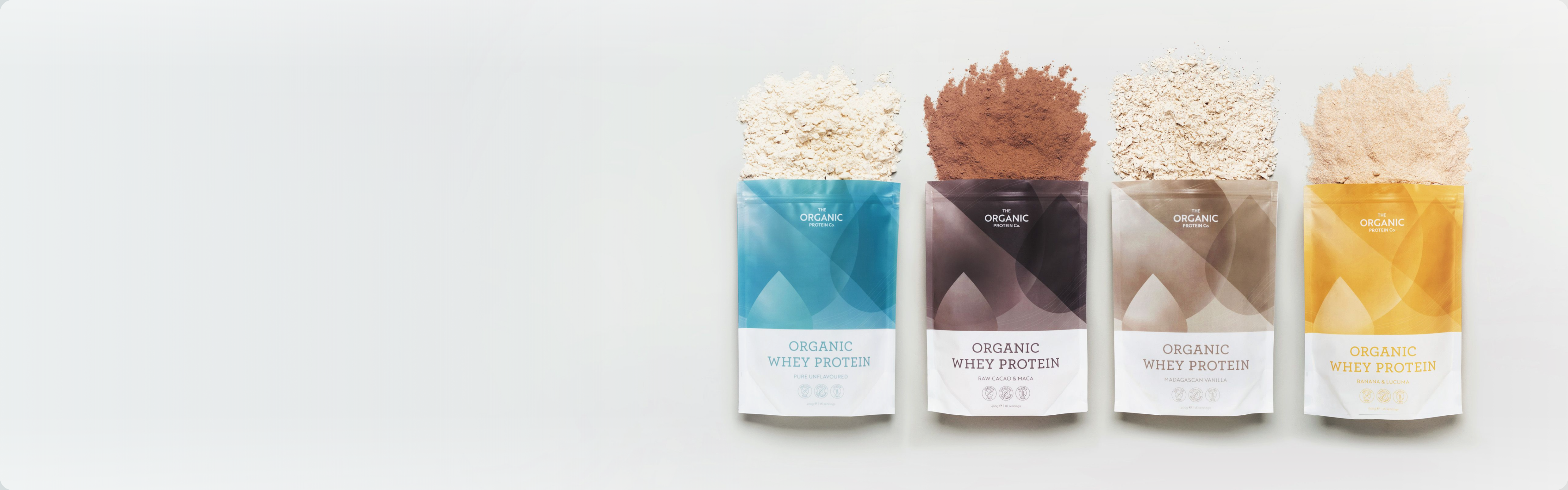



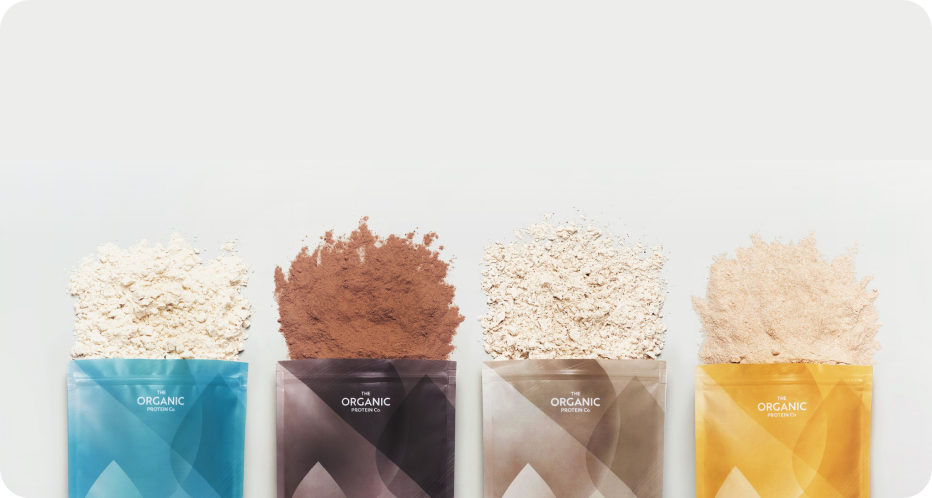


Walk down any supermarket aisle or scroll through wellness content online and it’s easy to come away with the impression that organic certification automatically means healthier produce. Organic protein is no exception, so you may be wondering if organic whey is more nutritious, or if its value is found somewhere else entirely?
To explore this properly, we need to separate nutrition from ethics, marketing from meaning, and evidence from assumption.
Ben Adams is an arable farmer in Oxfordshire. Known for pushing innovation within cropping systems, Ben is an expert in creating agro-ecological farming systems and able to help us understand how organic protein differs from non-organic protein.
Why Does the Question Around Organic Protein Exist?
Confusion around organic protein is common. It sits at the intersection of farming practices and complexity, marketing language, and genuine consumer concern.
“Many people don’t fully understand the inputs involved in organic versus conventional farming systems,” Ben says. “This can include uncertainty around what’s allowed, what’s restricted, and how those decisions affect production efficiency, land use, and cost.”
There’s also a persistent belief that organic means completely chemical-free, which isn’t strictly accurate and can add to any misunderstanding.
“Marketing hasn’t helped,” Ben adds. “Vague terms like ‘natural’ or ‘clean’ have no legal definition but are often used to imply trustworthiness or superiority.”
“On social media, repeated claims can quickly harden into ‘truths’, regardless of nuance or evidence.” But with a cost of living crisis and rising food costs, it’s no surprise that people wonder if organic protein is a better, and therefore justifiable, purchase.
Is Organic Protein Actually More Nutritious?
This is usually the core question, and from a macronutrient perspective, organic protein is not inherently more nutritious than non-organic protein. Ben reminds us that, “protein content, calorie count, and fat levels can be broadly similar when you’re comparing like for like.”
However, it’s important to remember that nutritional equivalence doesn’t mean there aren’t benefits to organic products such as organic whey protein.
Organic farming and production systems rely on fewer synthetic inputs such as artificial fertilisers, pesticides, and medicines such as routine antibiotics.
Two products can list the same grams of protein while differing in amino acid balance, processing methods, and bioavailability. Those differences are influenced by many factors beyond whether a product is organic, including filtration, heat exposure, and formulation.
While organic produce is not nutritionally superior by default, this doesn’t mean that it doesn’t have inherent value.
What Does Organic Refer to in Protein Production?
Organic certification isn’t a marketing label, it’s a regulated production standard.
In the UK, organic dairy and protein production must be certified by bodies such as the Soil Association or Organic Farmers & Growers (OF&G).
At The Organic Protein Co., whey protein is certified organic by The Organic Food Federation, in keeping with strict EU organic standards.
Organic certifications place clear requirements on how animals are raised and how crops are grown.

Farming standards, feed quality, and chemical restrictions
Conventional farming systems can focus on long-term soil health and ecological balance using artificial inputs within legal limits.
Organic farmers have similar soil health goals, but they must rely on different methods. “Instead of artificial fertilisers,” Ben explains, “organic farms rely on crop rotations, clover and grass leys, manure, and natural fertility to support plant growth.” Because synthetic fertilisers and pesticides aren’t permitted, farmers must build soil fertility through rotation and integrated management.
Ben notes that feed standards are also tightly controlled. “Organic livestock must consume organic feed, with a strong emphasis on forage such as grass and silage. However, conventional systems may supplement with grains or approved by-products.”
Chemical use is restricted but not eliminated entirely in organic farming. Synthetic pesticides and fertilisers are prohibited, while naturally derived products may be permitted. Antibiotic use is limited and regulated, rather than routine.
In contrast, pesticide use, medications and other synthetic inputs may be routinely chosen in conventional farming systems to prioritise yield and land-use efficiency.
Where Does the Real Value of Organic Protein Lie?
Organic protein’s value becomes clearer when you move beyond nutrition alone.
Farming practices and environmental impact
Organic farming avoids artificial fertilisers and synthetic pesticides, relying instead on natural nutrient cycles. This can support soil structure, microbial diversity, and wider ecosystem health.
However, there’s a trade-off. Organic systems typically produce lower yields, meaning more land is required to generate the same amount of food or protein. Environmental impact, therefore, isn’t a simple good-versus-bad equation as it depends on how sustainability, land use, and productivity are weighed.
Animal welfare and feed standards
Animal welfare is a defining feature of organic protein production. “Organic dairy standards mandate access to grazing for a set number of days per year, alongside specific housing and welfare requirements,” Ben says.
Feed must be organic, forage-based, and aligned with natural feeding behaviours. For many consumers, these welfare standards are a key reason for choosing organic produce, regardless of nutritional equivalence.
Reduced chemical exposure
Organic production involves reduced use of artificial fertilisers and synthetic pesticides. While organic systems may still use approved natural inputs that leave residues, overall chemical exposure within the production system is lower.
At The Organic Protein Co., fresh organic whey is cold filtered without chemicals. This means that beneficial bioactive proteins such as immunoglobulins and lactoferrin are preserved, ready to support wellbeing in numerous ways.
While reducing chemical exposure does not guarantee specific health outcomes, the production philosophy remains important to many consumers.
Find out more about the relationship between protein gut health, digestion and nutrient absorption.
Why Nutritional Value and Ethical Value Are Different
Nutrition answers one question: what does this food provide my body?
Ethical value answers another: how was this food produced, and do I want to support that system?
The importance of each question is personal. As Ben notes, everything sits in balance.
For some people, nutritional adequacy at the best price point is the priority. For others, animal welfare, environmental impact, traceability, or food system transparency carry greater weight.

Choosing Organic Protein as an Informed Preference
Organic protein doesn’t need exaggerated claims to justify its place.
Choosing organic can be a values-based decision rooted in support for specific farming practices, welfare standards, and reduced reliance on synthetic inputs. It can also be a decision informed by transparency; knowing how food is produced, not just what it contains.
As Ben puts it, “it comes down to whether consumers believe the organic production system is something they want to support, and whether the organic premium aligns with their priorities. In many ways, consumers need to speak with their wallet.”
For those who value traceability, animal welfare, environmental considerations, and food system transparency, this is where the real value of organic protein may lie.
If you’d like to understand more about protein, you might find it helpful to read our articles on how protein interacts with gut health, digestion and nutrient absorption, and why some protein benefits aren’t felt straight away.